The History of the harp in England
![]() |
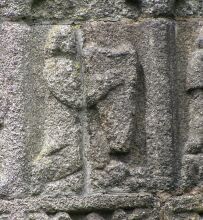
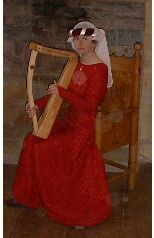
"And in his harping, when he had songe, his eyen twinkeled in his head aright, as don the starres in the frosty night." Chaucer's Friar Left, The shadowy outline of a harper, parish church, Launceston, Cornwall, 16thC. Right, Sarah with her reproduction English medieval harp |
![]() |
Much has been written and documented about the history of the harp in the Celtic areas of Britain, but not so much information has been made available, or time spent on research into the existence of harps and harpers specifically in England. Its a subject in which Sarah Deere-Jones has always been interested, and this page is an attempt to gather early historic information, references, photographs and depictions of harps and harpers in England. Contributions and corrections or enquiries will be gratefully received, please e mail info@cornwallharpcentre.co.uk if you can add to the collection, tip us off about any other harps hiding in churches or references about real harpers from history in England.
The harp has acquired great symbolic significance in Ireland Scotland and Wales, and also amongst their celtic descendants around the world. It has become a potent symbol of an exclusive 'Celtic' identity and its image and music is widely used as an attractive focus of nationalistic pride. But the original Celtic peoples came to the British Isles before the Roman occupation, from central Europe, and colonised England before progressing to their northern and western outposts, leaving their settlements, graves, and hill figures scattered across the English landscape, and their genetics firmly imprinted on the present day English population! The harp came to the British Isles much later than the original 'Celts', appearing in crude stone carvings in Scotland and Ireland in the 8th and 9th centuries, then in England in the 12th, and later in Wales. Many years later It flourished and developed uniquely both in shape and repertoire in all of the 'celtic' areas, but in England its development was curtailed particularly badly, due to the same forces of political and religious discrimination that threatened it in the 'celtic' areas. However the presence of the harp and harpers in England throughout history cannot be ignored, and we can now all celebrate and cherish together, the little traces we have left of this fascinating and beautiful instrument's history, wherever they may be found.
Romantic theories and common myths
The Romans used a simple lap sized harp and as they lived in England for over 300 years it is not impossible that at some stage they brought a harp along with them! The vikings are also sometimes credited with having a harp, although there is no evidence of a viking harp, as opposed to lyre, having been in England. The word 'harp' is first used in England by the Saxons, but there is a huge problem with translation as the Saxon word 'Harp' meant 'to play a stringed instrument' and cannot be assumed to be an actual harp as we would recognise it today. The writings of Beowulf contain some intriguing refences - "There was the noise of the harp, the clear song of the poet.......There was song and sound altogether before Healfdene's chieftains; the wood of joy was touched, the song was often sung.......The beast of war touched the joy of the harp, the wood of pleasure."
It is very tempting to assume he is talking about a real harp but sadly no evidence exists that there were harps in Saxon England although certainly there was a type of lyre. The Sutton Hoo burial treasure, now in the British museum, that was discovered in the 1960s contained fragments of what is often described as a harp, but it is actually a Lyre and bears no resemblance to what is generally acknowledged today as a harp.
![]() |
![]() |
![]() |
![]() |
Left to right, Beverley minster carving 14thC, Beverley minster misericord 1505, Exeter cathedral minstrels gallery 13thC, Manchester cathedral misericord 1505
(Both the porcine harpists above were made by the same craftsmen in Ripon and installed in the seperate buildings above.)
![]() |
The 7th century Saint Aldhelm, bishop of Sherborne, is said to have played a harp to his flock, and here is a lovely bronze of him doing that outside the present abbey in Dorset, but this sculpture is a modern interpretation, again no evidence exists that he really played a harp. Later in the 10th century, St Dunstan, Archbishop of Canterbury, was apparently charged with sorcery, because his 'harp' would play by itself when taken out in the wind! Exactly what instrument he had is again unknown. |
Actual evidence
So when DID the harp first arrive in England? Any of the above theories are plausable, but when it comes to actual claims we have to stick to hard evidence. The earliest carvings of harps in England known to date, are from the12th century. St Margarets church, Darenth, in Kent has perhaps the ealiest example, a fine carving of a harpist on the Norman font dated 1140. Nearby in the church of St Nicholas, Barfreston, has a fantastic carved frieze around the south door, containing a fox harpist, dated 1175. Dorchester Museum contains a wonderful worn carving of a hare playing the harp from Portesham, also from the 12th century. These early carvings from the south, may possibly have some connection with the Normans who of course invaded and settled 100 years before and started drastically influencing church architectures and styles. The Normans were known to have a small triangular framed harp.
![]() |
![]() |
![]() |
Left, Darenth harpist 1140, Middle Barfreston harpist (fox) 1175, both in Kent. Right Portesham harpist (Hare) 12thC (Dorset)
Of course the presence of carvings are not strictly evidence that harps were there at the time, among the populace. It is true that in the case of some large ecclesiastical establishments, craftsmen were imported from abroad during the construction, and stone carvers may have come from Europe and be carving musicians they had seen thousands of miles away! So we have to be careful with our interpretation of these little characters and what they mean. However, where there are many examples and where these examples are found on smaller more humble buildings too, the craftsmen are unlikely to have been imported, and local craftsmen were known to depict characters they had seen, sometimes even in their own communities.
Stone and wooden carvings of harpers like these from the 12th century onwards, can be found at Exeter, Christchurch, Broad Chalke Wiltshire, York minster, Beverly minster, Hexham Abbey, Manchester, Barfreston Kent, Darenth, Adderbury Oxfordshire, Ware Herts, March Cambs, Lincoln Cathedral, Salisbury & Exeter Cathedrals, Tewksbury, Norwich, Canterbury, to mention just a few.
![]() |
![]() |
The above English harps are interesting due to their unusual shapes. The left hand carving from Christchurch Priory in Dorset (14thc) appears to show the harp the wrong way round! This may either be a one-off unusual harp, or it may be a case of the carver working from memory and getting confused! This is quite common in early illustration and there are several examples of dodgy looking harps in medieval manuscripts and woodcuts where the harps are wildly inaccurate! The right hand carving from Lincoln Cathedral dated 1275 shows what is often described as the 'Irish' shape, with the bigger soundbox and more pronounced curve of the pillar. This shape is sometimes claimed to be uniquely Irish, but here it is in England in back in 1275! There are two separate 'Irish' shaped harp carvings at Lincoln, and another one at Ware, Hertfordshire dated 1380.
The carving of the 'Launceston harper' at the top of this page, can be seen on the outside of the parish Church in Launceston, Cornwall, it dates from the 16th century and is fairly typical of the quality of minstrel carvings across England on parish churches and cathedrals. They are vague to put it mildy, and unless you know what you are looking for, and are indeed looking for it, it is not at all obvious what they are! Generations of people have filed in and out of their parish churches every sunday and not realised a little musician was looking down at them from the tower or porch! For this reason until recently so many have remained undiscovered.
![]() |
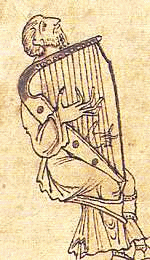
There are beautiful illustrations of harps in the Caedmon manuscript (11thC) the English psalter (c1050), St Albans psalter (12thC), the York psalter (c1170), the Harley psalter (c1000) the St Alban's psalter (12thC) as well as the Sherborne Missal here which dates from 1400-1407 (left). In her book 'The Harp' Roslyn Rensch when referring to European manuscript illustrations says "In English examples particularly the harps may vary in decoration and in number of strings, but certain basic characteristics are evident. The instruments are depicted with increasing attention to detail, and the various representations leave little doubt that a known musical instrument served as the original prototype for many of the drawings". |
![]() |
Angel harpist- 13th century quire screen,
|
In his book 'The story of the harp in Wales' Ossian Ellis says "Because of the lack of specific verbal and pictorial evidence on the history of the harp in Wales the musicologist and scientific researcher will, no doubt, insist that the harp came from England; yet the circumstantial evidence of the early poets, of the laws of Hywel Dda, and of the stories in the Mabinogion literature, suggest that the harp was known in Wales since time immemorial." Again the problem with the early Welsh literary references mentioned above, is exactly what instrument is meant by the word 'harp' which is, without accompanying illustration, difficult to confirm.
![]() |
Wall painting on Longthorpe tower, Cambridge, 1330 Watercolour copy by E Clive Rouse |
![]() |
Angel playing harp, Gloucester Cathedral choir- circa1340 |
![]() |
Harper with Crowder, (wooden panel) this piece of furniture however originated in Wales as the Edgcumbe family had strong links - Sir Piers wife was Welsh, her first father-in-law, Sir Rhys ap Thomas was one of the great patrons the arts in Wales Cotehele House Cornwall, 1550-70 |
![]() |
St Breage church- Cornwall, wall painting, detail of Christs hand with small harp illustrated above thumb, 15thC |
The examples above are some of the more unusual depictions of early harps in medieval England. We are discovering more and more examples - wooden carvings, stone carvings and paintings both on manuscripts and on walls, as well as numerous literary references regularly, which seem to indicate to us that the sight and sound of a harp was not all that unusual in England at the time.
Medieval stained glass examples however are rare, and whilst there are many beautiful depictions of harpists in that medium, either in the form of King David or as angels, many of them turn out to be Victorian, such as those below which are from Tavistock church, Devon.
![]() |
![]() |
![]() |
However there are older depictions of harpers in medieval stained glass at Fairford church in Gloucestershire.There, some of the oldest and most wonderful medieval stained glass in the country has survived, unfortunately the harpists were very small and high up, and too dark to photograph successfully!
Literary references and illustrations
There are beautiful illustrations of harps in the English psalter (c1050), St Albans psalter (12thC), and the York psalter (c1170). But as well as the above iconographic examples, there are many literary references, albeit frustratingly brief and vague about the presence of harpers across England.
In his 'Ancient music of Ireland' Edward Bunting quotes an often repeated English legend "In A.D. 878 when the great Alfred, assuming the character of a harper, with an attendant to carry his instrument according to the custom of the minstrels, entered the Danish camp, where he played before their princes". The same legend is repeated in the 10th century with Aulaff king of Northumberland who disguised as a harper played to King Athelstan. King Arthur is said to have done it too, and even the legendary character Tristan also disguised himself as a harper - it seemed to be a popular hobby here in the dark ages, and indeed the way this story keeps repeating leads it into the realm of popular legend rather than historical fact!
However, fascinating historical houshold records are far more intrigueing - for example there is a record of a harper being paid at the abbey of Hyde, near Winchester in 1180, his name was Galfrid, or sometimes referred to as 'jeffrey', but nothing more is known about him. Another famous story tells us of Blondel, the minstrel of Richard 1st, who it is said as his 'harper' found the king during his imprisonment in Austria, by playing outside the castle walls, and hearing the king answering the tune (in the style of a modern aural test no doubt!!) confirmed his presence. There are records from 1271 that Henry 3rd paid Richard his harper, 40 shillings and a pipe of wine, and Edward 1st in 1271 took his harper to the holy land with him, where apparently his minstrel saved him from an attack by an assasin. In the household records of Alice de Bryene, a Suffolk heiress of the late 14th century, mention is made of a payment to a harper who came to a feast at her manor -Acton Hall, on shrove tuesday one year to entertain the household for a few days. An account of the coronation of Henry 5th in 1413 at westminster by Elmham, includes the passage "The harmony of the harpers, drawn from their instruments, struck with the rapidest touch of the fingers, note against note, and the soft angelic whispers of their modulations, are gratifying to the ears of the guests."
There is a reference in Cornwall to a 'wandering' harper called 'Tristram' who by 1574 had a permenant position at Lanherne, but one of the most fascinating records of this period is also taken from Buntings 'Ancient history of Ireland' where he says, "towards the end of the 16th century, AD 1596 the 39th year of Elizabeth, a statute was passed by which 'minstrels wandering abroad' were punishable in the same manner as 'rogues vagabonds, and sturdy beggars'. This act, Dr Percy (in his admirable essay on the ancient English minstrels) considers as having put an end to the profession in England." Elizabeth the 1st is thus often credited for being reponsible for wiping out the Irish harpers, and if that is the case, it is also logical to assume that life would have become even more difficult for the wandering harpers in England to carry on with their profession under the more immediate threat of the guardians of her court.
The remnants of harpers in Britain somehow managed to carry on to a limited degree and hold on to their instruments, In Cornwall a Richard Cleere of Calstock bequeathed his harps to two blind boys in 1606. In 1619 an Irish harp was left in the will of Richard Connocke of Calstock. In 1792 in Belfast a meeting was held to gather all the remaining harpists of ireland together, this meeting was attended by an English music student - Edward Bunting, who notated the music played saving it for posterity, and left us one of the most interesting sources of historical information on the harp we have today.
"I can nat tabre, ne trompe, ne telle faire gestes,
Ne fithelyn at festes, ne harpen" Piers Plowman/Langland 1332-1400
"mery it is in halle, to here the harpe
the mynstrall synge, the jugelour carpe" Adam Davy 1312
"Ther herde I pleyen on an harpe
that souned bothe wel and sharpe
Orpheus ful craftely.
And on his syde, faste by
sat the harper Orion,
And Eacides Chiron,
And other harpers many oon,
And the Bret Glascurion;
And smale harpers with her glees." Chaucer 15thC, House of Fame.
Later History
There are many examples across England of how the harp was used in domestic entertainment of the wealthy in the late 18th and 19th centuries, perhaps the most obvious ones being the instrument's appearances in novels such as those by Jane Austin, Thackeray, George Elliot and Thomas Hardy. I have two worthless antique prints of gothic style harps, probably dating from around 1830 with their very feminine looking owners posing next to them in a domestic setting. Manuscripts survive of dance tunes, both for solo harp and arrangements with other instruments under the common phrase 'for harp or piano'. I have in my possesion an undated manuscript but probably from the early 19th century of arrangements and original pieces by John Parry, Oliver Davies, Augustus Giani and John Hughes, which would have been perfect soiree pieces for evening entertainment. I also have a manuscript of similar date, containing short 'Quadrilles'- dance tunes, arranged for harp and published by a Mr Paine of Bond Street London, who apparently directed a dance orchestra that performed at a club there known as 'Almacks'. This book also shows instructions for dancers under the notes.
Harps in dance bands were known across the country, here in Cornwall a Mr John Old or Par, was a music and dance teacher in the 19th century, his manuscript of pieces which contain well known English dance tunes, some local variations and some which appear to be originals, has particular reference to one as a 'Harp solo'.
But the most impressive contribution that England and in particular, the West country, has to offer the world of the harp, has to be that of the birthplace of Elias Parish Alvars in Teignmouth, Devon in 1808. He was the second child of Joseph Parish, organist of St James' church in the town, a music teacher and music shop owner. Elias Parish, had harp lessons from his father at the age of 3, and when he was 10, performed his first solo concert at Totnes. He eventually started travelling to London to have lessons with Nicholas Boscha the famous French Harp virtuoso who was the first harp professor at the Royal Academy of Music (although he was later sacked for bigamy and bankruptsy!). Elias travelled and studied across Europe and obtained a phenomenal technique, becoming the foremost harpist of his day. He began writing fiendishly difficult solo pieces for harp which are still considered an important addition to the harp repertoire today, and which earned him the nickname the 'Liszt of the harp'. Elias died in 1849 at the age of forty and is buried in Vienna.
Elias' pupils included Gottleib Kruger, who in turn was teacher to Hasselmans, leading to the French school - Salzedo, Tournier, Jamet, Zabaleta, Grandjany, & Laskine and therefore the very establishment of modern classical harp technique! A fascinating booklet about his life has been written by John Wilson Smith, and is available from Teignmouth Museum.
---------------------------------
![]() |
This page is in continual construction as research is ongoing, please do contribute any comments or information you know of particularly of early history of the harp in England. We are not historians but unlike some websites, we do try to be realistic and accurate! Many thanks to contributors and photographers!- Phil Williams, Mike O'Connor, Sean Stewart, Eric Johnson. If you are interested in early minstrels depicted in churches, you need to obtain a copy of 'Minstrels and Angels' by Jeremy and Gwen Montagu, published by Fallen Leaf Press in California - our bible and an excellent source book of information. |
![]() |
info (at) cornwallharpcentre.co.uk
Home | Courses & Tuition | Sarah Deere-Jones | Sheet Music and CDs | Ensemble | History